

Hong Kong public supports ivory ban
UPDATE! 29 May 2015: China agrees to phase out its ivory industry to combat elephant poaching
Last month Saving the Wild interviewed Dr Elizabeth Quat, a Hong Kong lawmaker that has made it her mission to lobby the Hong Kong and mainland China government to ban the domestic trade of ivory. This exclusive story for Virgin Unite can be found here.
“China’s President is on a mission to stamp out corruption, and with enough momentum this will become the new culture. Bribes are on the decline, and a lot of people are not buying gifts for government officials anymore.”
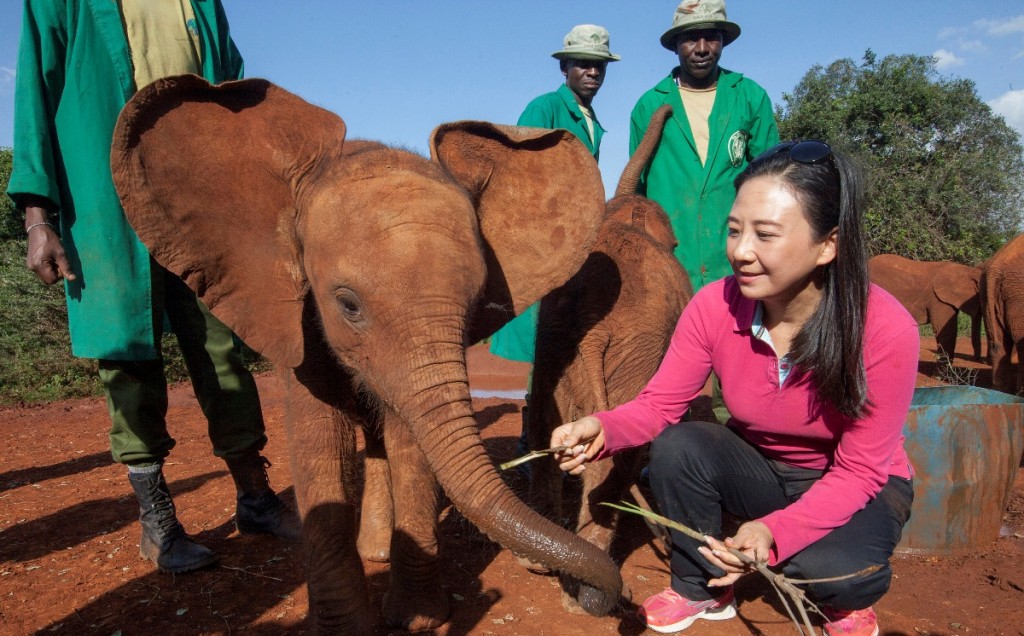 Photo credit: WildAid
Below is a progress update on this story. As elephant poaching crisis continues, three-quarters of citizens living in key ivory market support a comprehensive sales ban.
Press release: WildAid. Hong Kong Public Supports Ivory Ban
HONG KONG (May 26, 2015) — The Hong Kong public overwhelmingly supports a comprehensive ban on elephant ivory sales, according to a new survey conducted by the University of Hong Kong’s Public Opinion Programme: 75% percent of the 1,021 respondents expressed support for outlawing ivory sales, which are poorly regulated in Hong Kong. Of those in favor, 55% “very much support” a ban, while 21% “quite support.”
Additionally, three-quarters of respondents agreed that the Hong Kong government should stop issuing new ivory possession licenses.
The survey also found:
• Only 34% knew that African elephants could become extinct in the wild within our lifetime if current poaching rates continue.
• Only 26% believed that ivory poaching is linked to militant groups and organized crime.
• 84% of respondents knew that it’s illegal to import or export ivory from Hong Kong without a license.
• 71% knew that an elephant must be killed for poachers to collect tusks.
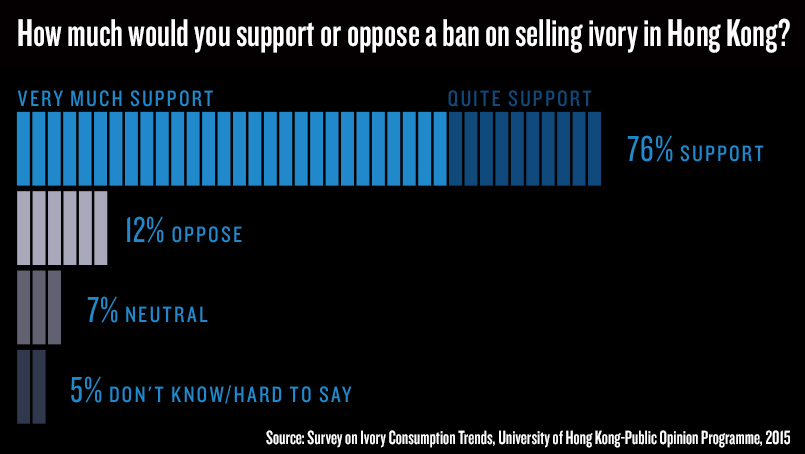
The survey was commissioned by WildAid, Save the Elephants and African Wildlife Foundation, and is supported by Hong Kong lawmaker Elizabeth Quat of the Democratic Alliance for the Betterment and Progress of Hong Kong (DAB).
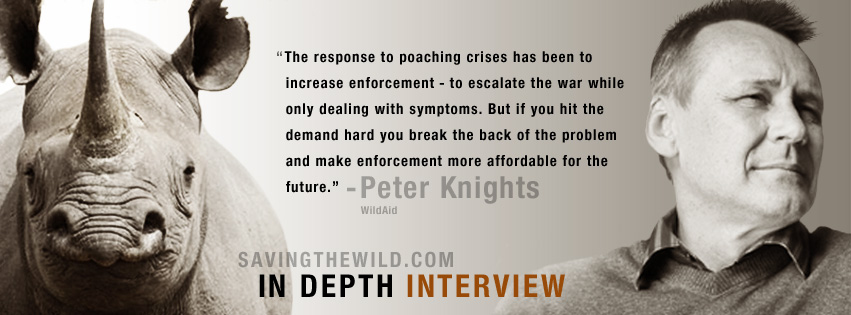
“Hong Kong’s ‘legal’ ivory stock was largely derived from elephants poached in the 1970s and 1980s before the international trade ban. Stocks have not been physically inspected and provide a perfect cover for the laundering of new illegal ivory,” said WildAid CEO Peter Knights. “Traders have had 26 years to liquidate their stocks. It’s time to close this open door for poaching.”
Elizabeth Quat said, “The Hong Kong people have spoken. They clearly want the government to ban this immoral trade which not only profits from the deaths of thousands of endangered elephants, but also is harming China’s flourishing business relationship with Africa.”
WildAid, African Wildlife Foundation and Save the Elephants are running a major public awareness campaign in mainland China to reduce the demand for ivory. The campaign uses public service announcements, billboards and subway ads featuring some of China’s biggest celebrities, including former NBA superstar Yao Ming, action hero Jackie Chan and top Chinese actress Li Bingbing, as well as The Duke of Cambridge (Prince William), David Beckham and others.
Two years in, the campaign has significantly increased awareness of today’s poaching crisis, and is now active in Hong Kong, Thailand and the United States — all major ivory consumers.
“I think something we see in this survey is that while citizens in prime ivory markets such as Hong Kong are increasingly equating ivory products with elephants killed, they aren’t connecting it with elephant extinction,” said Dr. Patrick Bergin, African Wildlife Foundation CEO. “We need to make it clear that what we’re talking about is species extinction. Those are the stakes, which is why we need even the people who don’t own ivory to at least own this issue and advocate on behalf of elephants.”
“Hong Kong has long been a hub for the illegal ivory trade, and suffers from weak ivory licensing controls,” said Alex Hofford of WildAid Hong Kong. “Without using expensive radiocarbon analysis technology it is absolutely impossible for anyone in the market to distinguish so-called legal old stocks from newly poached ivory.”
 Photo credit: Jamie Joseph / savingthewild.com
The Hong Kong government’s inaction on the issue is perpetuating a modern-day elephant poaching crisis. Hong Kong’s Secretary for the Environment KS Wong should legislate for a total ban on ivory sales in Hong Kong by setting a reasonable date for the city’s ivory traders to finally dispose of their stocks – after which time no more ivory can be legally sold.
Chan Yung, a member of China’s National People’s Congress, said, “At the Chinese Government’s National People’s Congress annual meeting in March, I felt honoured to submit a bill suggestion to the Standing Committee to ban China’s legal trade in ivory. Now that this has been suggested, we are stepping up our efforts to lobby the Hong Kong government to ban the ivory trade in our city. Hong Kong’s legal ivory trade masks a parallel trade in illegal ivory. This is aggravating Africa’s efforts to stem wildlife poaching, harming China’s international reputation and must be banned immediately.”
Recent good news stories from Saving the Wild…
Solving poverty saves elephants
An open letter to Global Citizens fighting to save elephants and rhinos
One woman’s mission to ban the ivory trade
Join the conversation on Facebook and Twitter.